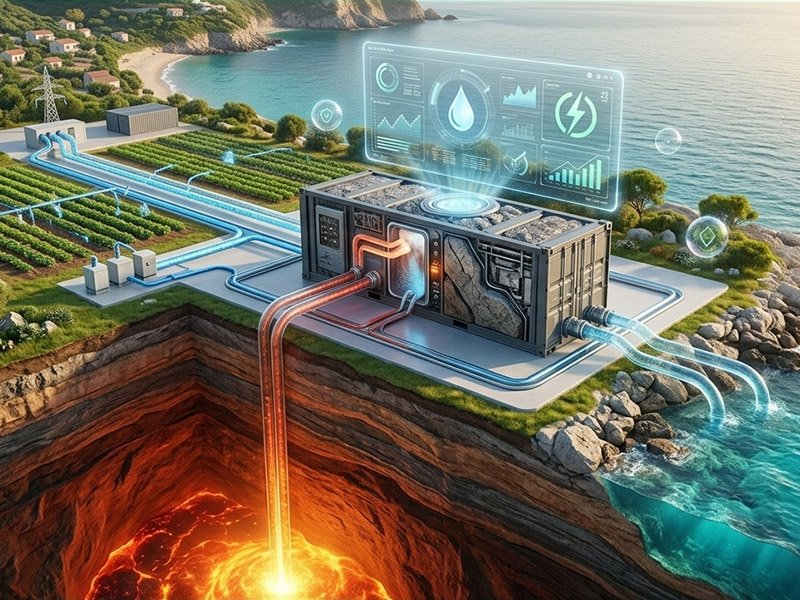
Global resource scarcity extends far beyond clean electricity; fresh water access is rapidly becoming an equally critical industrial and humanitarian crisis. Traditional desalination plants are notoriously expensive to operate, primarily because they consume vast amounts of electrical grid power to force water through reverse osmosis membranes. Peep BlackBox solves this by leveraging raw geoplutonic heat to create a revolutionary co-generation system. We don’t just generate power; we utilize the byproduct of our thermal cycle to produce massive quantities of fresh water, achieving dual-resource independence.
Turning Saltwater into Megawatts
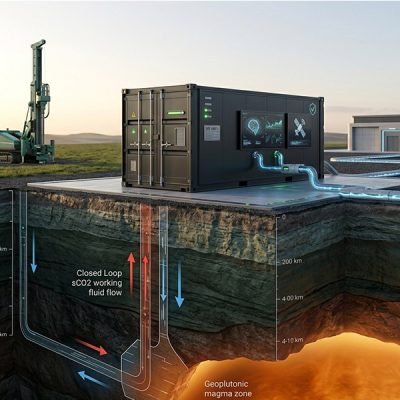
Instead of pumping and injecting water into the well—which can cause seismic issues—we deploy a closed loop inside the ultra-deep drilled space. This closed loop transports a fluid heated to approximately 300 degrees Celsius from depths of 4 to 10 kilometers. In coastal or saline-rich environments, we strategically use this intense thermal energy to turn not fresh, but salt water into steam to drive our turbines and produce electricity. Because the system is entirely closed-loop, there are no fractures, no obstructions, and absolutely no pollution exposition to the environment.
Agricultural Synergy and Zero Waste
The brilliance of this co-generation process lies in the exhaust cycle. After the steam drives the turbine, it condenses back into pure, desalinated water. This means the normally expensive desalination procedure becomes an integrated, cost-free part of our production process. This pure water can be immediately routed and used for large-scale agricultural irrigation, ensuring that less water needs to be abstracted from fragile rivers and lakes. Furthermore, the residual salt can be commercialized as a secondary revenue stream. The only emission from our entire power generation cycle is pure water.